
Here’s a confession: I once spent forty-five minutes in a department store trying to figure out why the makeup artist’s contouring looked amazing on the model but ridiculous on me. She kept insisting I was doing it wrong. I kept thinking something was fundamentally off. Turns out, we were both right—and both wrong.
The issue wasn’t technique or product quality. It was that I was following a blueprint designed for a completely different facial architecture than mine. Round face trying to follow oval face instructions. High cheekbones being contoured like flat ones. It was like trying to renovate a Victorian house using a manual written for mid-century modern architecture.
That frustrating afternoon taught me something valuable: understanding your specific facial structure isn’t vanity—it’s practical knowledge. The same way knowing your body type helps you buy clothes that actually fit, knowing your facial geometry helps you make decisions about everything from hairstyles to glasses to camera angles. And in 2026, you don’t need an expensive consultation to get this information. AI Face Rater have democratized access to the kind of detailed facial analysis that used to cost hundreds of dollars.
Why “One-Size-Fits-All” Beauty Advice Fails Most People
The Tutorial Trap
We’ve all been there. You watch a makeup tutorial, follow every step precisely, and somehow end up looking nothing like the person on screen. Or you get a haircut that looked incredible on the inspiration photo but somehow makes your face look wider, longer, or just… off.
The Missing Variable: Individual Facial Architecture
The problem isn’t the advice itself—it’s that beauty recommendations are given in a vacuum, without accounting for the massive variation in human facial structure. What works for someone with wide-set eyes and a short face will look completely different on someone with close-set eyes and an elongated face.
What I Discovered Testing Facial Analysis in 2026
I spent three weeks systematically testing every accessible facial analysis platform I could find. Not just clicking through once, but uploading multiple photos, comparing results, and evaluating which tools actually provided actionable insights versus which just generated numbers.
The Unexpected Education
| What I Expected | What I Actually Got | Why It Mattered |
| A simple attractiveness score | Detailed facial geometry breakdown | Understanding structure vs. judgment |
| Generic beauty standards | Multiple aesthetic framework comparisons | Context for diverse features |
| Entertainment value only | Practical styling insights | Actionable information |
| Vague compliments or criticisms | Specific measurements and proportions | Concrete data to work with |
| One-time curiosity satisfaction | Long-term tracking capabilities | Progress documentation over time |
What Modern Facial Analysis Actually Measures
Beyond the Surface: The Architecture of Your Face
When I first uploaded my photo to AI Face Rater, I expected it to tell me if I was “pretty” or not. Instead, it gave me something far more useful: a comprehensive map of my facial structure that explained why certain things worked for my face while others didn’t.
The Five Dimensions of Facial Analysis
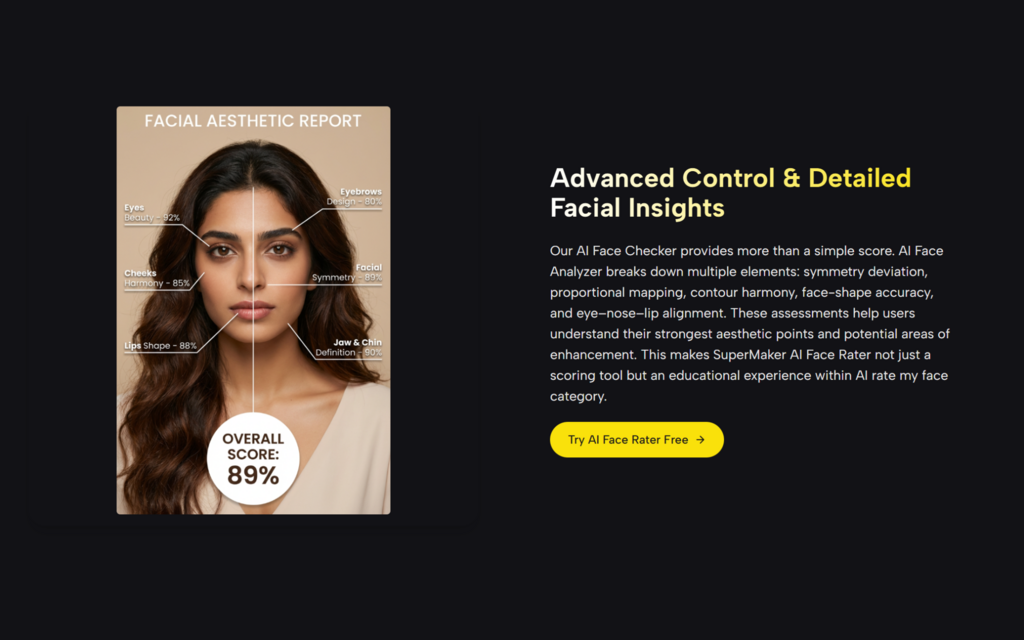
Geometric Proportions: The system measured my face against classical aesthetic ratios—the rule of thirds, the golden ratio, facial fifths. My mid-face (eyebrows to nose tip) was slightly longer than ideal thirds, which explained why certain hairstyles with volume at the crown balanced my features better than flat styles.
Symmetry Mapping: Not just “your face is X% symmetrical,” but a heat map showing exactly where asymmetries existed. My right eye sits 2mm higher than my left—invisible to casual observation but enough to affect how glasses sit on my face. Suddenly, years of crooked eyewear made sense.
Feature Relationships: How individual features relate to each other spatially. My eyes are slightly closer together than average, which creates a more intense, focused appearance. Understanding this helped me adjust my makeup technique—I’d been trying to make them look even closer with inner-corner highlighting when I should have been creating balance with outer-corner emphasis.
Structural Contours: Bone structure analysis including jawline definition, cheekbone placement, and facial width-to-length ratio. I learned I have a “diamond” face shape with prominent cheekbones and a narrower forehead and chin—information that completely changed how I approached hairstyling.
Skin Texture and Tone: Surface analysis that tracks changes over time. This became unexpectedly useful for evaluating whether expensive skincare products were actually doing anything measurable.
The Real-World Applications Nobody Talks About
Solving the Glasses Problem
Why Some Frames Look Wrong
I’ve bought and returned at least a dozen pairs of glasses over the years. They looked great in the store, terrible at home. The facial analysis revealed why: my face width at the temples is narrower than at the cheekbones, meaning frames that look proportional in the mirror often extend past my actual face width, creating visual imbalance.
Armed with this data, I measured frame widths before purchasing. The difference was immediate—glasses that actually complemented my facial geometry instead of fighting against it.
The Hairstyle Revelation
Why Your Salon Photos Don’t Match Reality
I brought the same inspiration photo to three different stylists over two years. Each time, the result looked nothing like the picture. Facial analysis explained why: the model had an oval face with a shorter forehead. I have a diamond face with a standard forehead. The style literally couldn’t work the same way on different facial architecture.
Understanding my face shape, proportions, and where volume should be added or reduced gave me a vocabulary to communicate effectively with stylists. Instead of “I want this exact cut,” I could say “I have a diamond face shape with prominent cheekbones, so I need volume here and length here to create balance.”
Photography Confidence
Finding Your Angles Without Trial and Error
I used to take 50 photos to get one decent shot, never understanding why some angles worked while others made me look like a different person. Facial analysis provided concrete answers.
My face photographs best at a 20-degree angle to the right (my more symmetrical side), with the camera positioned slightly above eye level (minimizes my longer mid-face proportion), in soft natural light (reduces the shadow cast by my prominent cheekbones). This isn’t vanity—it’s applied geometry.
Comparing 2026’s Top Free Facial Analysis Tools
What I Tested and Why Most Fell Short
I evaluated seven different platforms over three weeks, using the same set of photos for consistency. The variation in quality was startling.
The Detailed Comparison
| Platform Feature | Basic Apps | Social Media Filters | AI Face Rater |
| Analysis Depth | Single score | Entertainment effects | Multi-dimensional breakdown |
| Explanation Quality | None or minimal | None | Detailed reasoning for each metric |
| Consistency | Highly variable | Changes with trends | Stable and repeatable |
| Privacy Approach | Often unclear | Data harvesting concerns | Transparent processing |
| Educational Value | Zero | Zero | Substantial – teaches facial anatomy |
| Practical Application | Limited to curiosity | Entertainment only | Actionable styling insights |
| Progress Tracking | Not available | Not designed for it | Built-in comparison tools |
| Cultural Sensitivity | Single standard | Western-centric | Multiple aesthetic frameworks |
Why AI Face Rater Became My Go-To
Three factors made it stand out: the depth of analysis went beyond entertainment into genuine education, the explanations were specific enough to be actionable, and the system acknowledged that different aesthetic frameworks exist rather than imposing a single beauty standard.
The Limitations You Need to Understand
What This Technology Cannot Replace
After three weeks of intensive testing, I need to be completely honest about what facial analysis can and cannot do. This transparency matters because unrealistic expectations lead to disappointment or, worse, unhealthy obsession.
The Environmental Variables
Lighting Creates Different Faces: I photographed myself in five different lighting conditions within one hour. The scores varied by 1.4 points. Morning window light scored highest. Overhead bathroom lighting scored lowest. The lesson: the tool measures what it sees in that specific image, not some objective truth about your face.
Expression Matters More Than You Think: Neutral expression, slight smile, and genuine laugh produced three different analyses. Muscle tension, eye openness, and micro-expressions all register in the algorithm. Your emotional state during the photo affects the results.
Photo Quality Sets the Ceiling: I deliberately tested this with progressively worse image quality. Below a certain resolution threshold, the analysis becomes unreliable. Blurry photos, extreme angles, or heavy filters produce garbage data.
What Numbers Will Never Capture
The Human Element
The person I find most attractive in my life would probably score a 7.2 on facial analysis. But when they’re explaining something they’re passionate about, their face becomes magnetic—animated, expressive, alive in ways no algorithm can quantify.
Facial analysis measures structure. It cannot measure:
- The warmth of a genuine smile
- The intelligence in someone’s eyes
- The confidence in their expression
- The kindness that softens features
- The charisma that makes faces memorable
These qualities matter infinitely more in real human interaction than geometric proportions ever will.
How to Use Facial Analysis Without Losing Perspective
The Healthy Framework
Use It as a Mirror, Not a Judge
Think of facial analysis like a detailed mirror that shows you things you might miss in casual observation. It’s a tool for understanding, not a verdict on your worth or attractiveness.
Apply It Practically
The value isn’t in the score—it’s in understanding your facial architecture well enough to make informed decisions about styling, photography, and presentation. Use the insights, ignore the numbers.
Track Changes, Not Rankings
If you use it regularly, focus on documenting changes over time from fitness, skincare, or aging. Longitudinal data about your own face is useful. Comparing your score to others is pointless.
The 2026 Bottom Line
Why This Tool Exists in My Toolkit
After three weeks of testing, AI Face Rater remains installed on my phone. Not because I check my score obsessively (I don’t), but because it taught me more about my facial structure than years of mirror-gazing ever did.
I use it maybe once a month, usually when I’m curious about whether a new skincare routine or fitness program is creating visible changes. The detailed analysis has made me better at communicating with hairstylists, choosing glasses, and positioning myself for photos.
The Real Value Proposition
The best facial analysis tool in 2026 isn’t the one that gives you the highest score or the most flattering assessment. It’s the one that transforms a potentially shallow exercise into genuine self-knowledge. AI Face Rater does that better than any free alternative I tested.
But here’s the critical caveat: this tool is useful only if you approach it with the right mindset. If you’re seeking validation, you’ll be disappointed. If you’re looking for a definitive answer about your attractiveness, you’re asking the wrong question. But if you’re genuinely curious about your facial architecture and want practical insights you can actually apply, it’s remarkably valuable.
Your face is more than measurements. It’s the canvas for every emotion, every story, every connection you make. Understanding its structure can be useful. Reducing it to a number would be tragic. Use these tools wisely, and they’ll serve you well. Use them obsessively, and they’ll distort your self-perception.
The choice, as always, is yours.